For you
Your next step.
Practise it first.
- Your dream job.
- Your first team.
- A hard conversation next week.
Whatever your next step, it brings a few conversations that matter. Practise them out loud first. An AI plays the other person, and you get honest feedback on what you said. Each time you practise, you're a little better prepared for when it counts.
Start practisingYou don't need an employer. Practise in English or Dutch. Plans from €10 a month, VAT included.
Can't you just use your own AI? Here is the difference.
What you can practise
The conversations a bigger role brings
Assessment centres often include a role-play. You read a briefing, then meet a difficult colleague or client while assessors watch what you actually say and do.
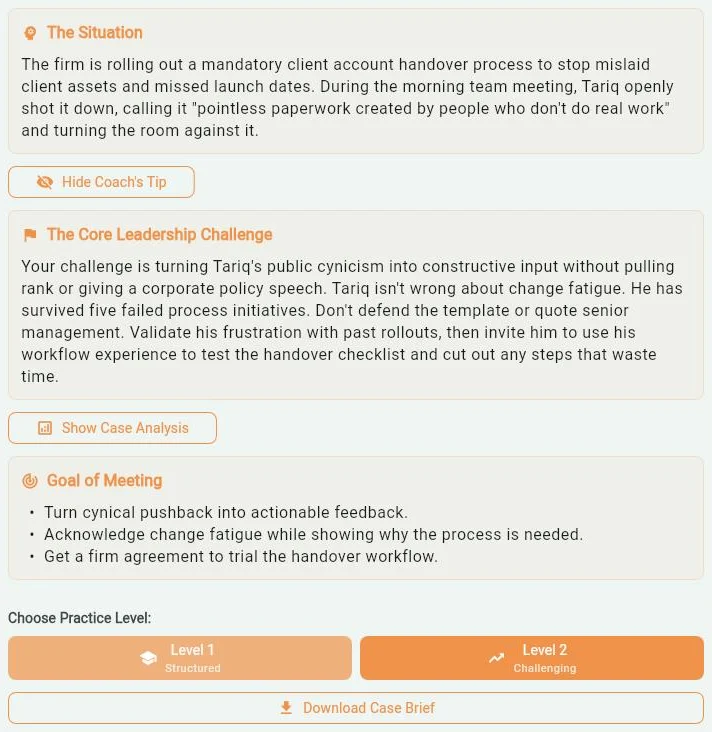
A HeyManager case is built in a similar way. You get a briefing and a goal for the meeting, and the character only opens up when you handle them well. The cases sit in the app's library, the Playbook. Here are two of them:
- Overcoming Cynical Change Resistance. A respected team lead called the new handover process you're rolling out “pointless paperwork” in front of the team, and you need him to trial it.
- This Is Not a Board-Ready Answer. After a presentation that went badly, you need the board chair's backing.
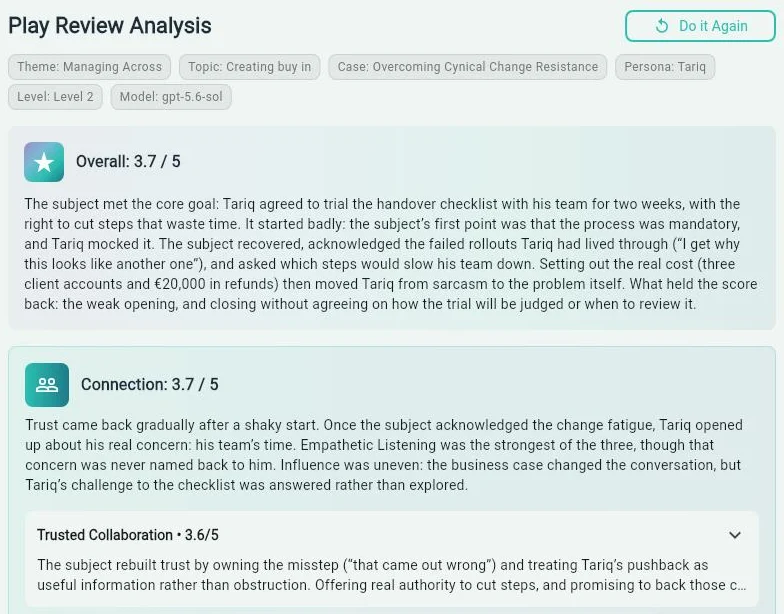
Each case is one conversation of around ten minutes, so it fits before the real thing rather than becoming a project of its own. After each conversation you get a Play Review: written feedback that scores what you said against six skills and gives the reason for each score. We borrowed the app's names from sport, where you practise before the game and review how you played afterwards.
Not sure which case fits? Describe what you're preparing for in Find the Right Practice. It suggests the closest cases and says how well each one fits. You can also set all your cases in a sector close to the job you want.
HeyManager is practice for the conversations employers test, not interview practice.
Honest feedback
Can't I just use my own AI?
You can, and it can help. You can even ask it to be blunt. General AI assistants are trying to help, but they tend to shape their feedback to the person asking and the way they ask. Most of us, without meaning to, ask in a way that invites the answer we hoped for. So two people can get different feedback on exactly the same thing. In one study, assistants gave more positive feedback on the same text when the person said they had written it, or liked it. People tend to prefer answers that agree with them, and those preferences are part of how assistants are trained.1
We already live with feeds that show us whatever keeps us looking. Practice needs the opposite. Being told what you want to hear feels good, but it isn't always good for you. In one recent study, people who talked through a real conflict of their own with an AI that took their side came away more sure they were right than those whose AI pushed back. They also rated the agreeing AI higher and wanted to use it again.2
HeyManager is not designed to tell you what you want to hear.
HeyManager is set up to assess, not to please. The review runs on the same kind of AI model as the assistants you know. What's different is the review's brief: written in advance, and the same for everyone.
You don't write the question.
The review is written from the case and what you said, to the same brief as everyone else.
One standard, written down in advance.
Everyone on a personal plan is measured against the same six skills, called The Game Plan.
The review doesn't know who you are.
The review isn't told your name, how you scored before, or which level you chose.
Every score has its reasons.
Each score is explained using what you said.
You could write yourself a careful prompt and reuse it. What you can't easily do alone is hold yourself to the standard everyone else on a personal plan is measured against, session after session. If your organisation gives you a plan, everyone in the organisation shares one framework.
A score can shift a little between reviews, and a misheard word can matter. The review reads the words of the conversation, not your tone of voice, face or body language.
Practice without real-world stakes
Nobody learns to ride a bike from a book
Some people find their balance sooner than others. But everyone who rides learned the same way: getting on, wobbling and trying again. Hard conversations work like that too.
You are not simply born a leader. Leadership is a practice made up of many smaller ones, built up throughout your life.
Confidence is built the same way. It grows when you try something yourself and see it go well. Being told you're good is not the same as having done it.
So if a hard conversation makes you nervous, that isn't a verdict on who you are. Nerves may just mean you haven't practised that conversation yet. In HeyManager you can, with nothing at stake. Start at Level 1, where the conversation has more structure, and step up to Level 2 when you're ready. Your score charts show what is changing.

Your practice is yours
No one at HeyManager reads your conversations, and if an employer gives you a plan, they don't see what you said or how you scored. Your results are for you to learn from, not a certificate for an employer, and you can delete everything yourself at any time.
The app has no ads, no trackers and nothing built to keep you scrolling. You pay for practice, not with your attention.
Plans and prices
Per month, VAT included. You choose a plan after you sign up.
Practice Essentials
€10Three practice sessions a month, the full Playbook, a Play Review after every session and your Skill Signature, a map of how you lead.
Practice Complete
€25Up to ten sessions a month, twenty follow-up questions about your feedback, and two progress reports that look across your recent sessions, plus everything in Essentials.
Coaching
On requestOne-to-one sessions with a human coach, separate from the monthly plans. We are opening coaching to a first group now: coaching@heymanager.io
Cancel at any time and keep access until the end of the period you paid for.
Walk in knowing what to say
The first go is usually a bit wobbly. Have it here, out loud, where a wobble doesn't matter. Then go again.
Choose a plan and startSources
- Sharma, M., Tong, M., Korbak, T., Duvenaud, D., Askell, A., Bowman, S. R., Cheng, N., Durmus, E., Hatfield-Dodds, Z., Johnston, S. R., Kravec, S., Maxwell, T., McCandlish, S., Ndousse, K., Rausch, O., Schiefer, N., Yan, D., Zhang, M., & Perez, E. (2024). Towards understanding sycophancy in language models. In The Twelfth International Conference on Learning Representations. https://openreview.net/forum?id=tvhaxkMKAn
- Cheng, M., Lee, C., Khadpe, P., Yu, S., Han, D., & Jurafsky, D. (2026). Sycophantic AI decreases prosocial intentions and promotes dependence. Science, 391(6792), Article eaec8352. https://doi.org/10.1126/science.aec8352