For organisations
Help your people
know what to say.
- Practice, the first time and every time.
- Your values, in every case.
- Anonymised patterns across the group.
- A say in what people practise, on request.
Your people practise the conversations that come with leading, out loud, with an AI playing the other person. Every case can be set inside your own company. You see how the group is doing and who has practised, but not what anyone said or scored.
Talk to usMonth to month, with no annual contract. You choose each person's plan, from €10 a person a month, VAT included. Practise in English or Dutch.
Set up your organisation yourself, or talk to us first.
Practice, the first time and every time
Promoted, then left to work it out
Many people are put in charge of others with no formal training in how to lead. In a 2023 YouGov survey for the Chartered Management Institute, 82% of people in the United Kingdom who became managers had not had any proper management and leadership training.1 The first time they give hard feedback, or hold someone to a commitment, is the real thing.
One reason so few get proper training may be cost: development centres are expensive to offer to everyone. Many training programmes do cover what to say, but there is little chance to practise saying it, and once the programme ends, there is often nothing to keep people practising.
HeyManager is that practice, and the practice works on the words. After each practice conversation, written feedback scores what was said, not tone of voice, face or body language. HeyManager won't do everything a development centre does, but we believe a monthly plan can take people most of the way to knowing what to say.
We kept the cases light on purpose. A development centre can take a day or more and mixes role-plays with analytical exercises. HeyManager keeps just the role-play: one conversation of around ten minutes, with feedback mostly on how you handled the person in it. That is light enough to keep up every month, which is the point.
Left to work it out, some people ask a general AI assistant how they did. Those assistants tend to shape their feedback to the person asking and the way they ask, so people can be told they did well and come away more sure of what they already thought. HeyManager's review is AI too, but nobody asks it anything: people don't write the question, the review isn't told who they are, and everyone in your organisation is measured against the same written standard. More on the difference.
Most people just don't know what to say.
So HeyManager's line is Know what to say.
Set in your company
Your values, in every case
Each person picks a case, such as a talk with a colleague who keeps missing deadlines, and practises it out loud. The cases sit in the Playbook, and the written feedback after each practice session is a Play Review. We borrowed the app's names from sport, where you practise before the game and review how you played afterwards. See how a session works.
Your HR manager fills in the Clubhouse, the app's page for your company: its name, sector and profile, vision and mission, core values and logo. From then on, everyone practises inside your company instead of a made-up one.
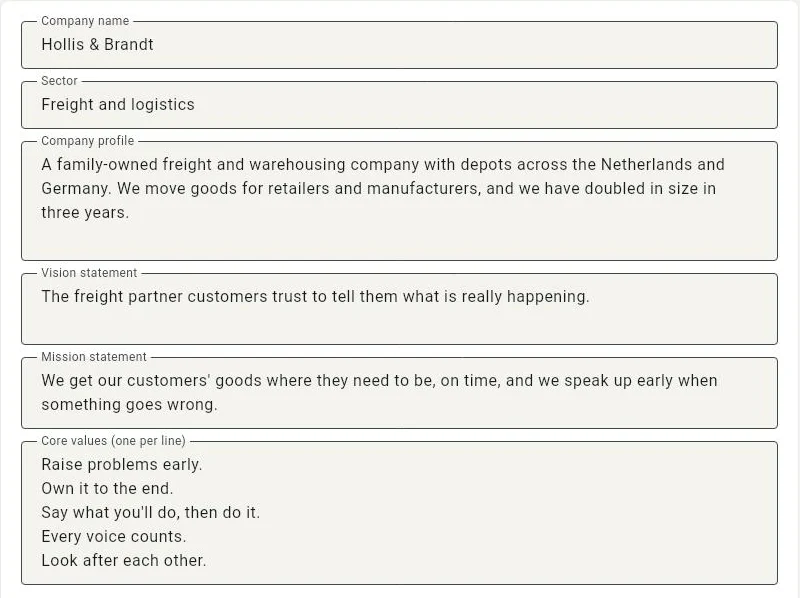
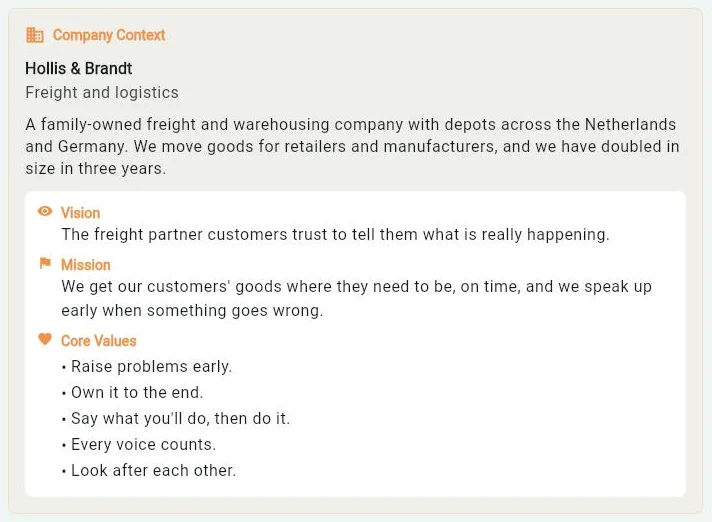
Every case sheet then shows your vision, mission and core values. They are in the case brief people can open during the conversation too, and the AI playing the other person is given the same context.
So each time someone practises, your values are in front of them. Your values set the scene.
Anonymised patterns across the group
How the group is doing, and who has practised
Team Stats and the Training Log sit in the Front Office, the part of the app for HR managers, next to the Clubhouse.
Team Stats
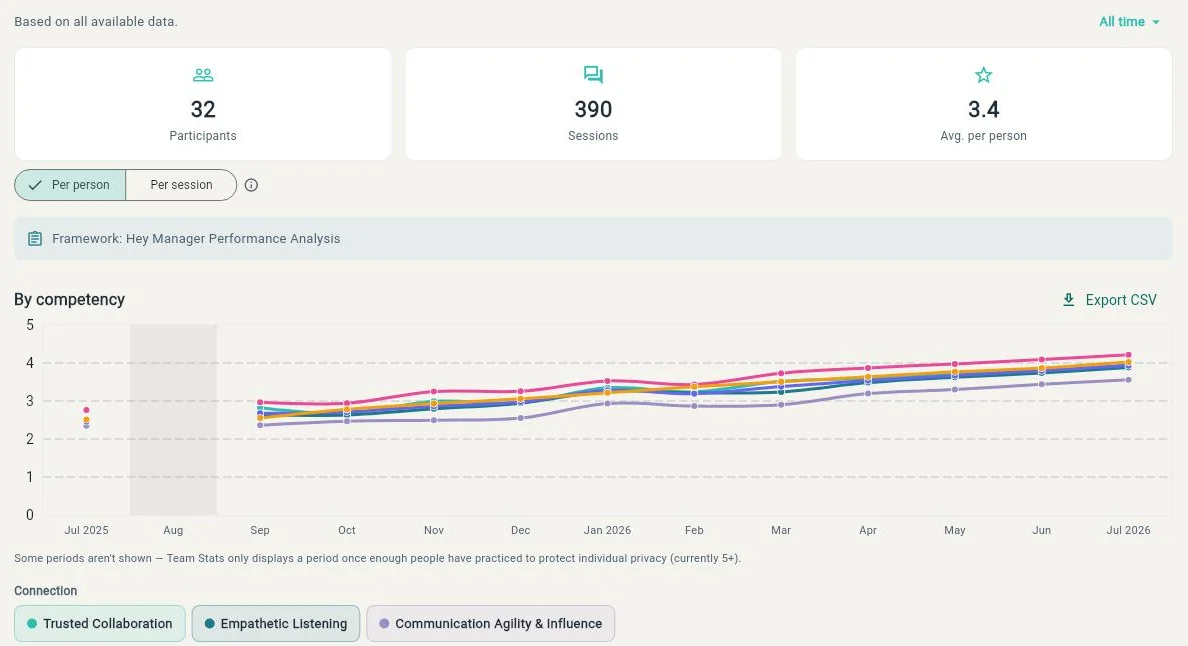
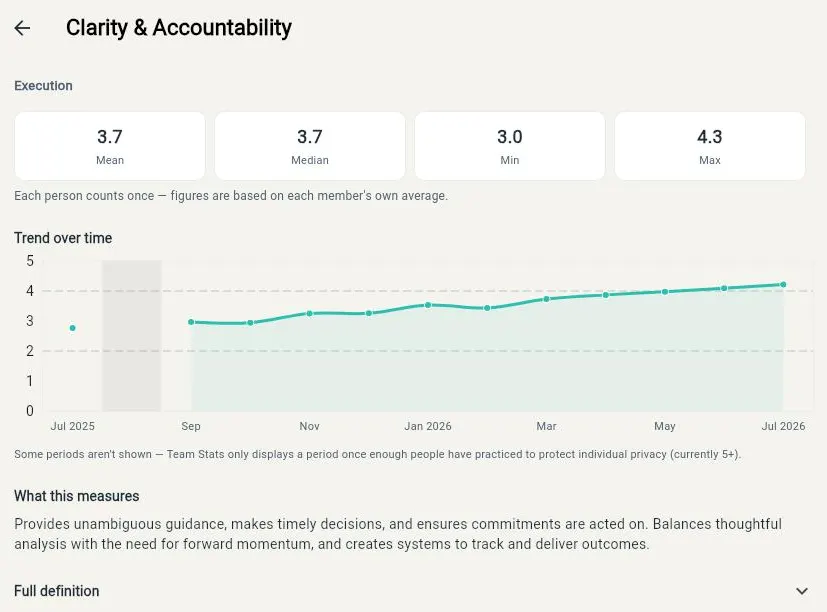
The group, anonymised: how many people took part, how many sessions, the average score and a monthly trend for each competency. Look back six months, a year or all time, and download the figures, without names, as a spreadsheet.
Nothing appears until at least five people have practised over at least seven days. Any month or competency with fewer than five people is left out.
Training Log
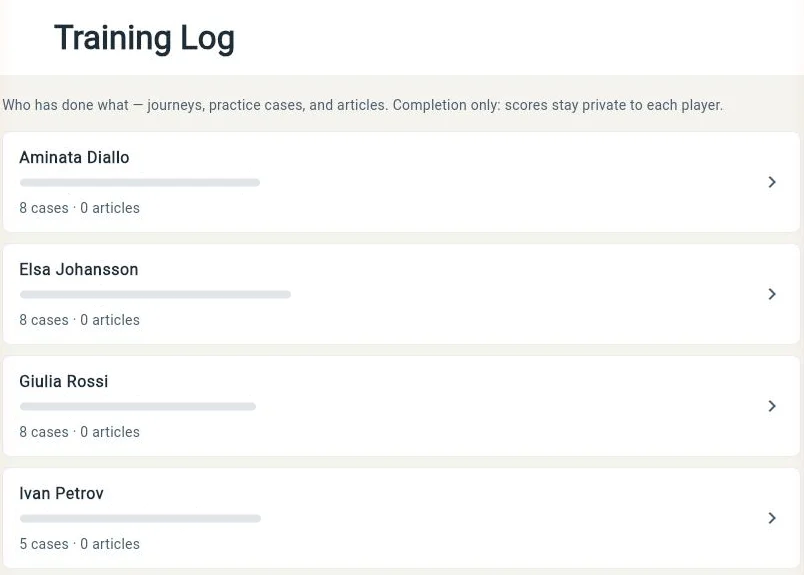
Who has done what: each person's name and email, the cases they have completed, the short articles on each competency they have read and, if you have a learning journey built with us, how far they are through it. Dates are rounded to the week.
The Training Log shows completion only: no scores, no conversations and nothing anyone wrote in a reflection.
Your people's practice stays theirs
Nobody in your organisation, including HR managers and admins, can see anyone's conversations or Play Reviews, or any score with a name attached.
You see names and completions in the Training Log, and anonymised figures in Team Stats. We think people practise more honestly when a clumsy first go can't be held against them, so tell them this before they start.
What we believe
Can you measure a culture? In the moments that matter, yes
A culture shows in how people behave in specific situations: how a manager answers a colleague who raises a problem, or follows up when a commitment slips. Those situations are what people practise here, and every review scores them against the things your company says matter: The Game Plan, or your own competency framework. Add everyone's scores together and you get a good measure of those things across your organisation: a steady read of the behaviours you care about, and one you can steer.
The read rests on consistency. At any one time, every Play Review is scored by the same AI model against the same written standard, each score out of 5. We believe one model, held to that standard, is more consistent than a panel of human observers, each with their own view.
One standard for everyone, added up.
One framework, written down.
By default it is The Game Plan: six competencies under three pillars, Connection, Execution and Vision.
Every score has its reasons.
Each score is explained from what was said.
Open any competency.
See what it measures, the behaviours that work and those that don't, its trend, and the mean, median, lowest and highest score. There is no breakdown by team, manager, case or person.
A score can shift a little between reviews, and a change of AI model can move scores too.
A say in what people practise, on request
Steer your culture, with us
We build each of these with you, separate from the monthly plans.
Your own competency framework.
Written for your organisation, it replaces The Game Plan in your people's Play Reviews and in Team Stats. The Skill Signature, a map of five leadership profiles people get after several sessions, is built on The Game Plan, so people on your own framework won't get one.
A learning journey.
Cases and articles, with a closing reflection, that point everyone towards the situations you care about.
Cases written for you.
Built around the conversations your people actually have.
Together, these give you a read on the behaviours that matter to you, and a way to point everyone's practice towards the culture you want.
Plans and prices
Per person, per month, VAT included.
For everyone who leads, from a team leader on the shop floor to an executive who would like to talk their results through with a coach. You buy seats and choose each person's plan. You don't have to put everyone on the same one. You can start with a few seats and add more later. Team Stats needs at least five people practising before it shows anything.
Practice Essentials
€10Three practice sessions a month, the full Playbook, a Play Review after every session and a Skill Signature.
Practice Complete
€25Up to ten sessions a month, twenty follow-up questions about their feedback, and two progress reports a month for the person practising, plus everything in Essentials.
Coaching
On requestOne-to-one sessions with a human coach, separate from the monthly plans. We are opening coaching to a first group now: coaching@heymanager.io
Billed monthly, with no annual contract. Add seats at any time, or remove ones nobody is using. If you cancel, access runs to the end of the period you paid for. People are invited by email and sign in with email, Google or Microsoft. Admin and HR manager roles are free and don't use a seat. To practise as well, they need a seat.
Let your people get it wrong in practice first
A first go at a hard conversation is usually a bit wobbly. Better here, out loud, than across the table from a colleague.
Talk to usOr set up your organisation now.
Sources
- Chartered Management Institute. (2023, October 16). New study: Bad managers and toxic work culture causing one in three staff to walk [Press release]. https://www.managers.org.uk/about-cmi/media-centre/press-releases/bad-managers-and-toxic-work-culture-causing-one-in-three-staff-to-walk/